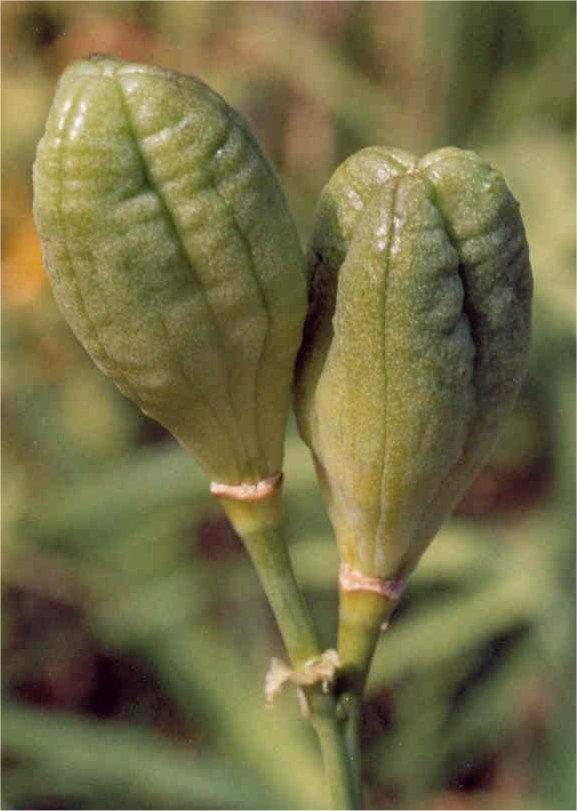
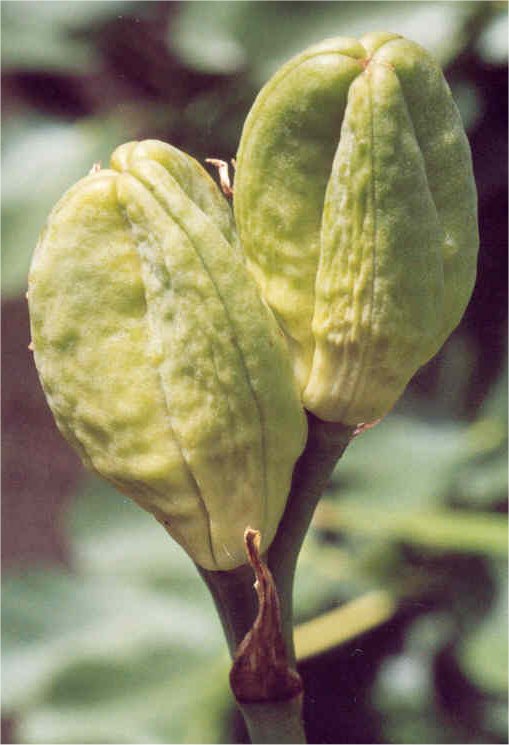
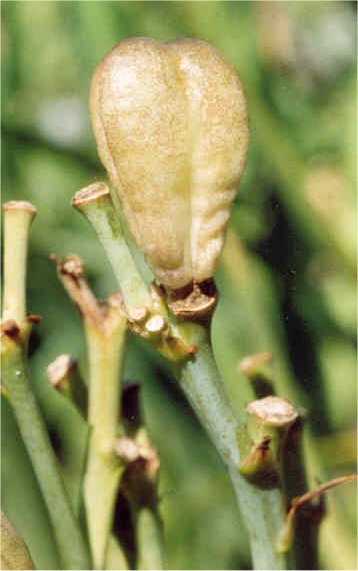
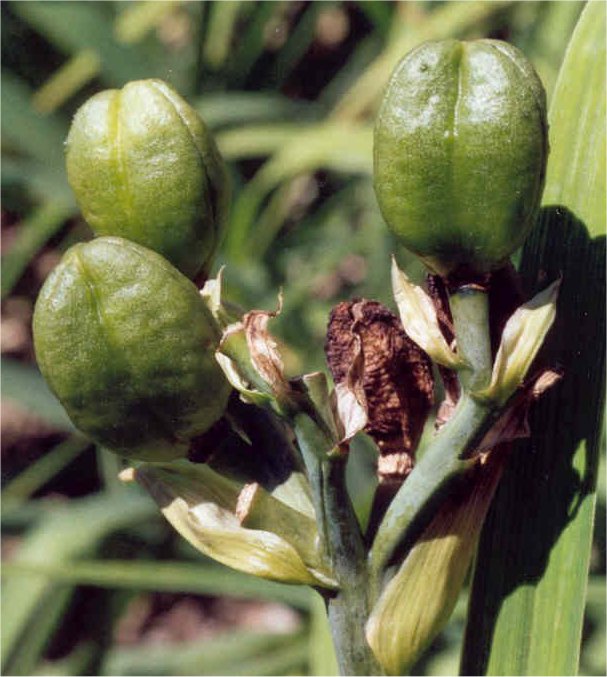
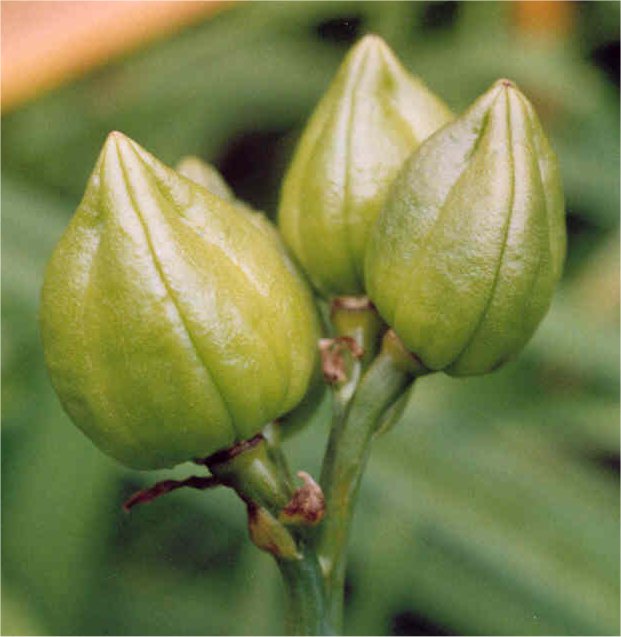
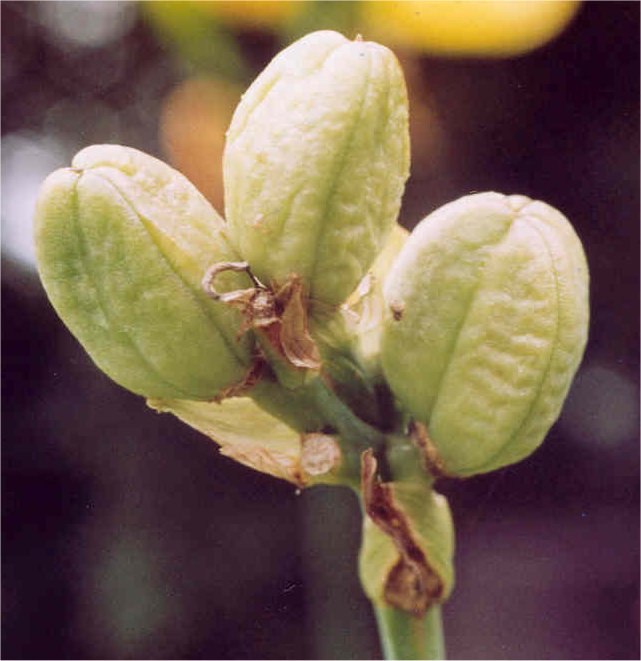
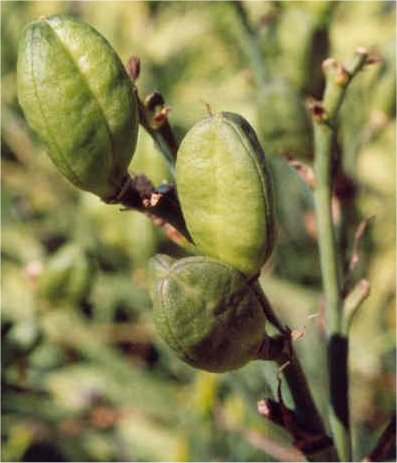
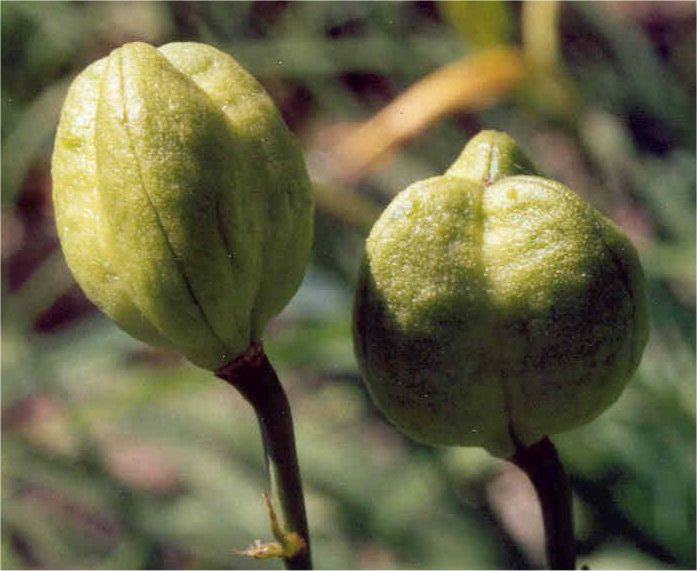
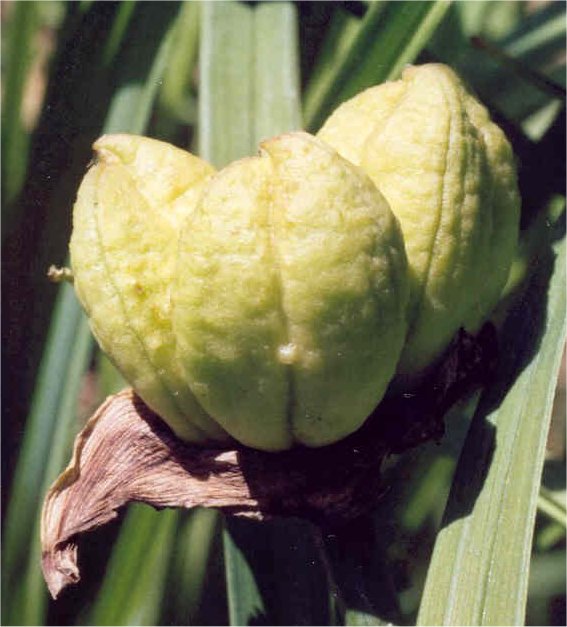
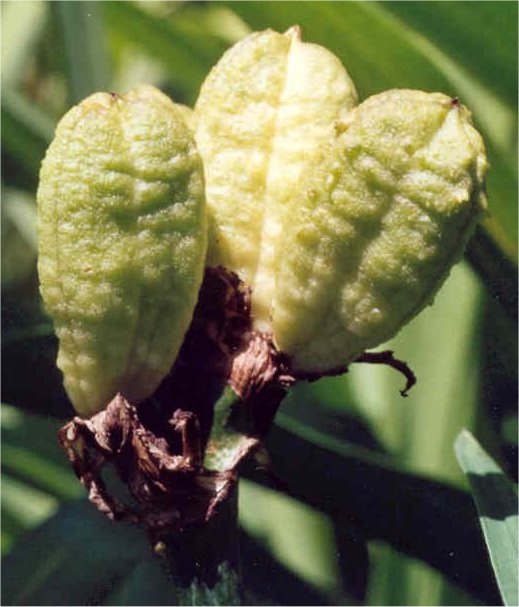
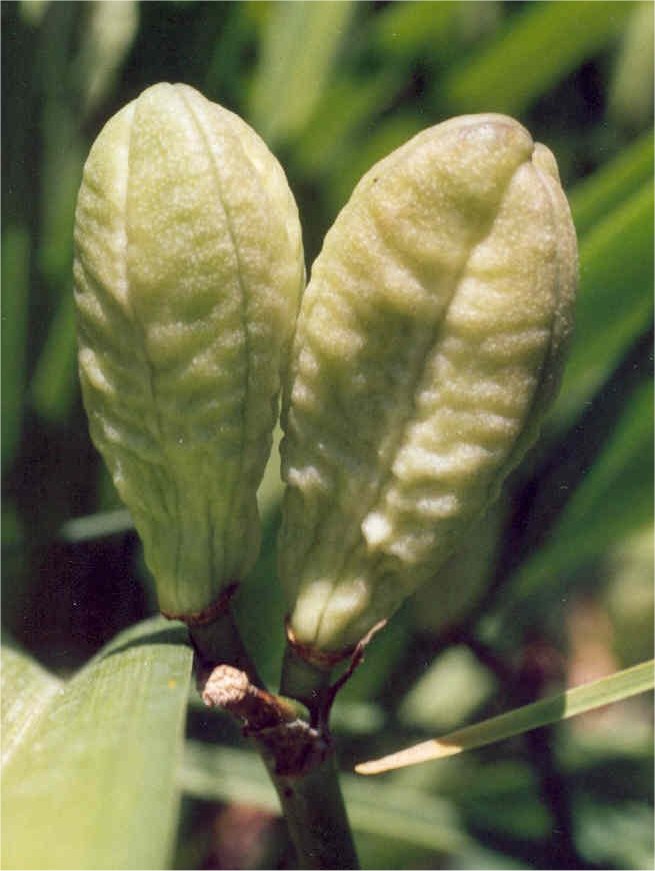
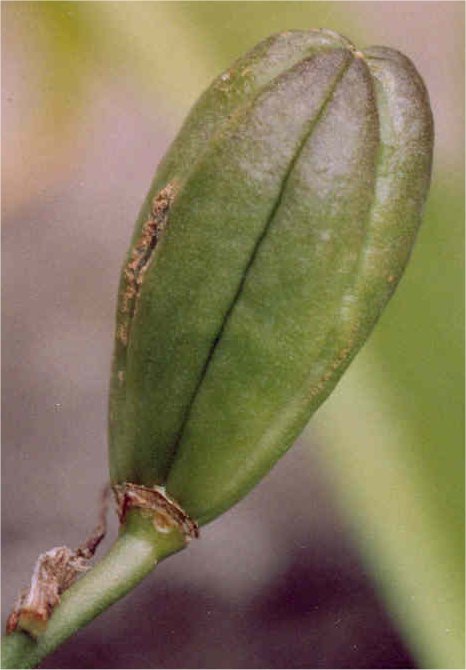
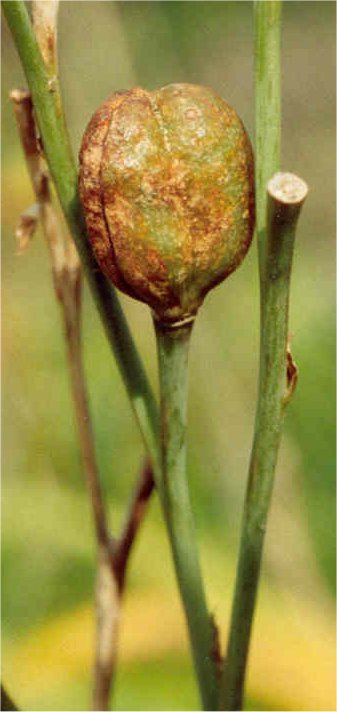
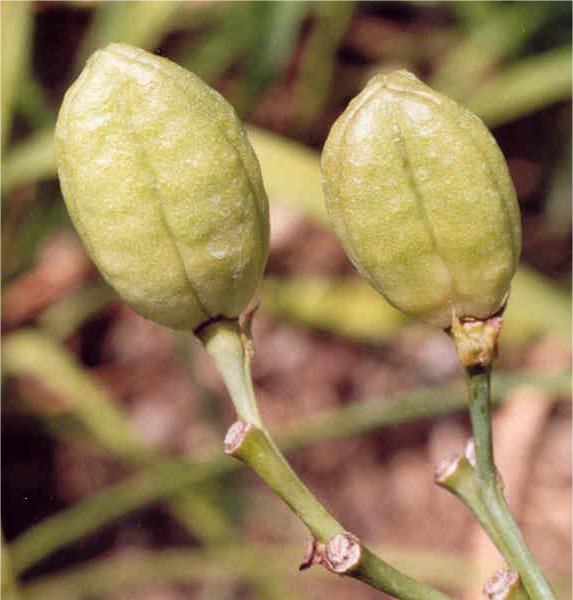
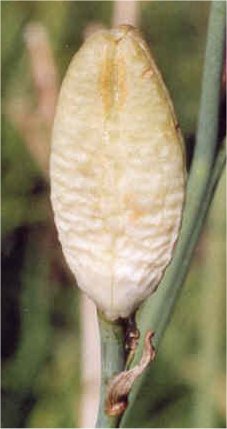
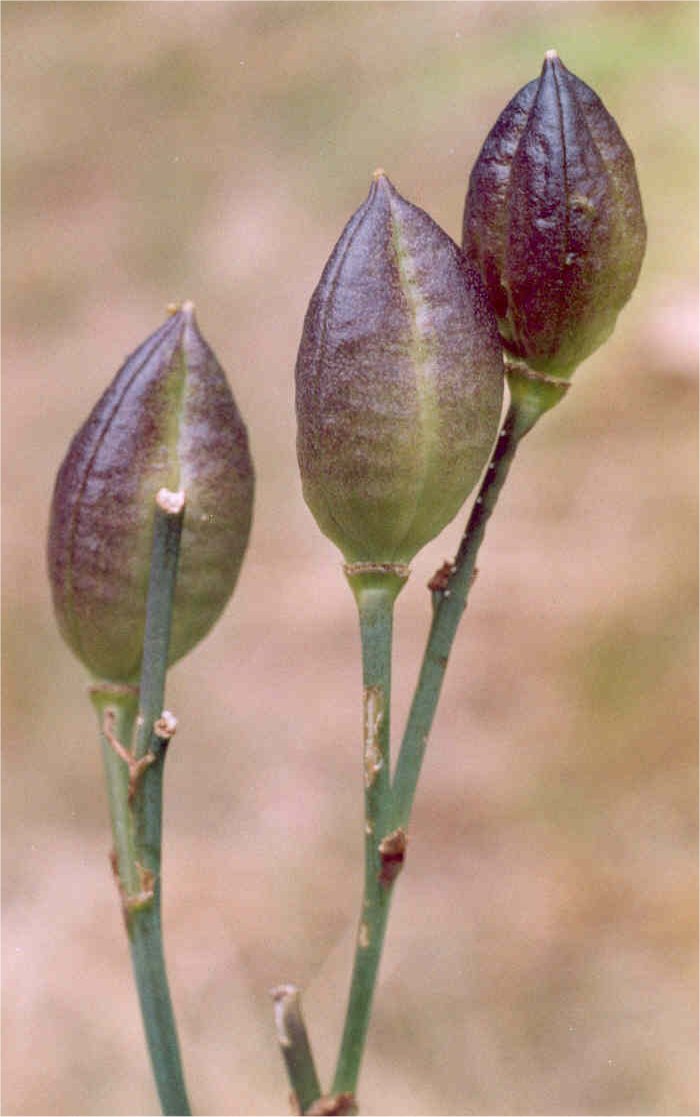
H. altissima [A.B. Stout, Herbertia, 1942, vol.9, p.103-106]
There is considerable variation in the size and shape of the capsules borne by different plants.
Well-developed capsules characteristic of different plants have ranged from one inch (2.5cm) to one and one-half inches (3.8cm) in length,
and for some plants the shape is oval with a rounded apex while for others the apex is truncated.
H. altissima [S.-Y. Hu, Daylily Handbook, 1968, p.90]
Capsules widest at summit, immature ones 7/8 in. long (2.2cm), 3/4 in. in diameter (1.9cm).
H. aurantiaca [A.B. Stout, Addisonia, 1929, p.25-26 + plate 461]
The largest of the capsules obtained by cross-pollination are nearly two inches long (5cm) and one inch in greatest diameter (2.5cm),
oval in outline, broadly grooved along the median line of each valve, obtuse and slightly indented at the apex.
H. aurantiaca [S.-Y. Hu, Daylily Handbook, 1968, p.91]
Capsules oblong, about 1.75 in. long (4.4cm), about 1 in. wide (2.5cm), obtuse at the apex.
H. citrina [E. Baroni, Ricerche Mus. Ort. Bot. Firenze, 1897, p.143-147 + plate 9]
Capsule leathery, trigonal, valve rugose, 2 1/3 - 3 cm long, 1 cm wide
( Capsula coriacea, trigona, valvis rugosis, 2 1/3 - 3 cm. longis, 1 cm latis )
H. citrina [A.B. Stout, Addisonia, 1930, p.3-4 + plate 482]
The capsules are usually about one inch in length (2.5cm), obovate, deeply and sharply grooved, indented and purplish at the apex.
H. citrina [S.-Y. Hu, Daylily Handbook, 1968, p.93]
Capsules 3-lobed, obovoid, 1-1.25 in. long (2.5-3.2cm), obtuse and notched at the rounded tip.
H. vespertina [H. Hara, The Journal of Japanese Botany, 1941, vol.17#3, p.119-129 (p.127-128)]
Capsule obovate, at the base abruptly narrowed, nearly 2.5cm long, transverse conspicuously veined rather regularly.
( Capsulae obovatae basi abrupte angustatae ad 2.5 cm longae transverse venoso-regulosae )
H. coreana [T. Nakai, Bot. Mag. Tokyo, 1932, vol.46, p.111-123]
Capsule appearance rugose-nervose apically emarginate 18 mm long 13 mm wide
( Capsula facie rugoso-nervosa apice emarginata 18 mm. longa 13 mm. lata )
H. coreana [S.-Y. Hu, Daylily Handbook, 1968, p.94]
Capsules ca. 1 in. long (2.5cm), 0.25 in. across (0.6cm), rugose, nervose, apical end emarginate.
(Mrs. Hu states that this is the English translation of Nakai’s original description, which is cited above)
H. dumortieri [A.B. Stout, Addisonia, 1929, p.27-28 + plate 462]
When well filled with seeds the capsules are slightly more than an inch in length (2.5cm), decidedly globose in shape,
slightly grooved, and somewhat depressed at the apex.
H. dumortieri [S.-Y. Hu, Daylily Handbook, 1968, p.94]
Capsules subglobose, ca, 1 in. long (2.5cm), 0.75 in. diameter (1.9cm).
H. esculenta [S.-Y. Hu, Daylily Handbook, 1968, p.95]
Capsules oblong, about 1 in. long (2.5cm), truncate and notched at the rounded tip.
H. exaltata [A.B. Stout, Addisonia, 1934, p.37-38 + plate 595]
The capsule is elliptic in longitudinal outline, about 4 cm. long and 2 cm. wide, and corrugated with numerous short ridges.
H. exaltata [S.-Y. Hu, Daylily Handbook, 1968, p.96]
Capsules ellipsoid, 1.5 in. long (3.8cm), 0.875 in. in diameter (2.2cm), obtuse at the tip, corrugated with numerous short ridges.
H. forrestii [S.-Y. Hu, Daylily Handbook, 1968, p.97]
Capsules oblong 1.5 in. long (3.8cm), 0.75 in. in diameter (1.9cm), obtuse at the tip, slightly rugose.
H. fulva [S.-Y. Hu, Daylily Handbook, 1968, p.97]
Capsules oblong, 1.25 in. long (3.2cm), 0.75 in. in diameter (1.9cm), tip truncate, often notched, with a short stipe at base.
H. fulva 'Maculata' [A.B. Stout, Addisonia, 1929, p.23-24 + plate 460]
The capsule (obtained only by cross-pollination) is broadly obovate, the apex broadly truncate and indented.
The median line of each valve is somewhat sharply and deeply grooved and the groove between the valves is sharp and narrow.
In shape, size and general character the capsule is typical for the cultivated H. fulva
(capsules obtained by cross-pollination) and for many of the wild plants of this species or of the types named
H. disticha and H. longituba.
H. fulva 'Maculata' [S.-Y. Hu, Daylily Handbook, 1968, p.99]
Capsules obovoid-oblong, tip truncate and notched.
H. fulva var. littorea [S.-Y. Hu, Daylily Handbook, 1968, p.104]
Capsules oblong, 13/16-1.125 in. long (2.1-2.9 cm), horizontally ribbed.
H. fulva var. longituba [A.B. Stout, Addisonia, 1930, p.5-6 + plate 483]
The capsules of all the wild varieties and of the cultivated clons of the species H. fulva are
very similar in shape and size, being rather broadly obovate, with the apex truncate and indented.
The median line of each valve is deeply grooved and the groove between the valve is sharp and narrow.
The capsule shown in Plate 483 was not fully ripe and is hence not of full size; the one shown in Plate 484 was fully ripe and
plump and it contained seeds.
H. fulva var. oppositibracteata [H. Kong. & C.R: Wang, Guihaia, 1996, vol.16(#4), p.303-304, fig.1]
Capsule obovate with 3 vertical notches (translated from Chinese text)
H. fulva var. rosea [S.-Y. Hu, Daylily Handbook, 1968, p.100]
Capsules oblong, 1.25 in. long (3.2cm), 0.75 in. diameter (1.9cm), tip subtruncate.
H. hakuunensis [T. Nakai, Journal of Japanese Botany, 1943, vol.19, p.312-319]
Capsule round-elliptic, top elevated-3-lobed, horizontally rugose, 20 mm long, 14 mm wide.
( Capsula rotundato-ellipsoidea apice elevato-3-lobata horizontali-rugosa 20 mm longa 14 mm lata. )
H. hakuunensis [S.-Y. Hu, Daylily Handbook, 1968, p.102]
Capsules broadly ellipsoid, 1 in. long (2.54cm), 0.75 in. in diameter (1.9cm), the tip with three elevated lobes, horizontally roughened.
H. hakuunensis [S.S. Kang & M.G. Chung, Sida, 1994, vol.16#1, p.23-31]
Capsule usually oblong-oval, 2.0-2.5 cm long and 1.1-1.5 cm wide cross-wrinkled when dried,
surface usually covered with wart-like projections, apex emarginated;
H. hongdoensis [M.G. Chung & S.S. Kang, Novon, 1994, vol.4, p.94-97]
Capsule somewhat large, 2.5-4.1 cm long, 1.7-2.5 cm wide, usually oblong-oval, rarely roundish, cross-wrinkled when dried,
surface usually covered with wartlike projections, apex emarginate
H. lilioasphodelus [A.B. Stout, Addisonia, 1929, p.17-18 + plate 457]
The capsule is three-celled, loculicidal, broadly elliptic in vertical outline, in median cross-section almost triangular,
broadly and slightly grooved along the median line of each valve, and sharply but very shallowly-grooved along the lines of juncture
between valves, the six grooves meeting at the apex in a slight indentation.
The capsules measure as much as one and three-fourths inches long (4.4cm) by one and one-fourth inches in diameter (3.2cm).
H. lilioasphodelus [S.-Y. Hu, Daylily Handbook, 1968, p.102]
Capsules ovoid-ellipsoid, 0.75-1.25 in. long (1.9-3.2cm), apiculate with persistent base of style, pericarp often tuberculate,
cross-wrinkled when dry.
H. middendorffii [A.B. Stout, Addisonia, 1929, p.29-30 + plate 463]
The capsules of H. Middendorffii are in general shape most similar to those of
H. flava and H. minor.
H. middendorffii [S.-Y. Hu, Daylily Handbook, 1968, p.105]
Capsules broadly ellipsoid, 1-1.25 in. long (2.5-3.2cm), 13/16 - 1 in. in diameter (2.0-2.5cm), corrugated with lateral ridges.
H. middendorffii var. longibracteata [Z. Xiong, Bulletin of Botanical Research, 1993, vol.13, no.2, p.122-123]
Capsule ellipsoid, shape obtuse triangular, 1.5cm long
( Capsulae ellipsoideae, facie obtuse triangulae, 1.5 cm longae )
H. minor [A.B. Stout, Addisonia, 1929, p.19-20 + plate 458]
The capsule is narrow-elliptic in outline, somewhat triangular in cross mid-section, broadly grooved along the middle of each valve,
and averaging one and one-half inches in length (3.8cm) and usually not as much as one inch (2.5cm) in greatest diameter.
The capsule is slightly more deeply and much more narrowly grooved than the capsule of H. flava.
H. minor [S.-Y. Hu, Daylily Handbook, 1968, p.107]
Capsules ellipsoid, 1 5/16 in. long (3.3cm), 0.5-0.625 in. in diameter (1.3-1.6cm).
H. multiflora [A.B. Stout, Addisonia, 1929, p.31-32 + plate 464]
The capsules are seldom more than an inch in length (2.5cm), slightly ovoid as in the Plate or are more obovoid.
The capsules are similar to those of H. thunbergii but are smaller and usually more grooved toward the apex.
H. multiflora [S.-Y. Hu, Daylily Handbook, 1968, p.107]
Capsules ovoid-oblong or obovoid, barely 1 in. long (2.5cm), 0.5 in. diameter (1.3cm).
H. nana [W.W. Smith & G. Forrest, Not. Bot. Gard. Edinb., 1916, vol.10, p.39]
Immature fruit in a dry state 1.5 cm long, around 1 cm broad.
( Fructus immaturus in sicco 1.5 cm. longus, circ. 1 cm. latus. )
H. nana [O. Stapf, Bot. Mag., 1923, vol.148, plate 8968]
The capsule is oblong, slightly widened upwards and 3 cm. long.
H. plicata [S.-Y. Hu, Daylily Handbook, 1968, p.109]
Capsules oblong, 0.75 in. long (1.9cm), 0.375 in. wide (1.0cm), tip truncate and sharp-pointed.
H. taeanensis [S.S. Kang & M.G. Chung, Systematic Botany, 1997, vol.22#3, p.427-431]
Capsule somewhat small, usually roundish, rarely oblong-oval, surface usually smooth or covered with wart-lake projections,
apex emarginate, 1.0-2.0 (mean 1.5) cm long, 0.8-1.2 cm wide
H. thunbergii [A.B. Stout, Addisonia, 1929, p.21-22 + plate 459]
The capsule is about one and one-half inches long (3.8cm), about three-fourths inch (1.9cm) in greatest diameter,
broadly blunt and almost truncate at the apex.
H. thunbergii [S.-Y. Hu, Daylily Handbook, 1968, p.109]
Capsules obovoid, 1-1.5 in. long (2.5-3.8cm), 0.875 in. in diameter (2.2cm), truncate and notched at the rounded tip,
abruptly narrowed at the base.
H. yezoensis [H. Hara, The Journal of Japanese Botany, 1938, vol.14#8, p.520-521]
Capsule oblong somewhat smooth or rugose.
H. yezoensis [S.-Y. Hu, Daylily Handbook, 1968, p.111]
Capsules oblong, rugose.